
Indian River County Court Records After a Jail Arrest
After an arrest in Indian River County, the booking happens at the jail, but the court record begins somewhere else. A judge reviews custody and bond at first appearance, then the State Attorney for the 19th Judicial Circuit decides which charges to file. That filing opens a case with the Clerk of the Circuit Court, and that case file is the court record people search for. The clerk notes that anyone arrested in the prior 24 hours appears before a judge every morning at 8:30 a.m., including weekends and holidays.
Keep the two sides separate. The arrest and booking side, including the mugshot and bond, lives on the jail roster, covered on the jail inmate records page, with booking photos on the jail mugshots page. The court record is the set of charges the prosecutor actually filed and how the case moved through the courts. The two often differ, and the booking profile itself tells readers to confirm final charges with the courthouse.
How to Find Indian River County Court Records After an Arrest
The court case index is run by the Clerk of the Circuit Court and Comptroller. The free public tool is Benchmark Online Case View, which searches civil, criminal, and traffic cases by name, case number, citation, or date. Public access does not require an account, though registered users and attorneys can see more documents. Charge detail and case status show inside each case, while the arrest and booking detail stays on the jail roster.
- Open Benchmark Online Case View at court.indian-river.org.
- Search by defendant name in Last, First order, or by case number.
- Open the case and read the charge list and the parties.
- Check each charge's level, code, and current status, and note court dates.
The public search uses a reCAPTCHA check, and case numbers follow a Year, Case Type, six-digit format such as 2004 TR 000123.
Open the Benchmark Online Case View search page to begin a court-records search after an arrest.
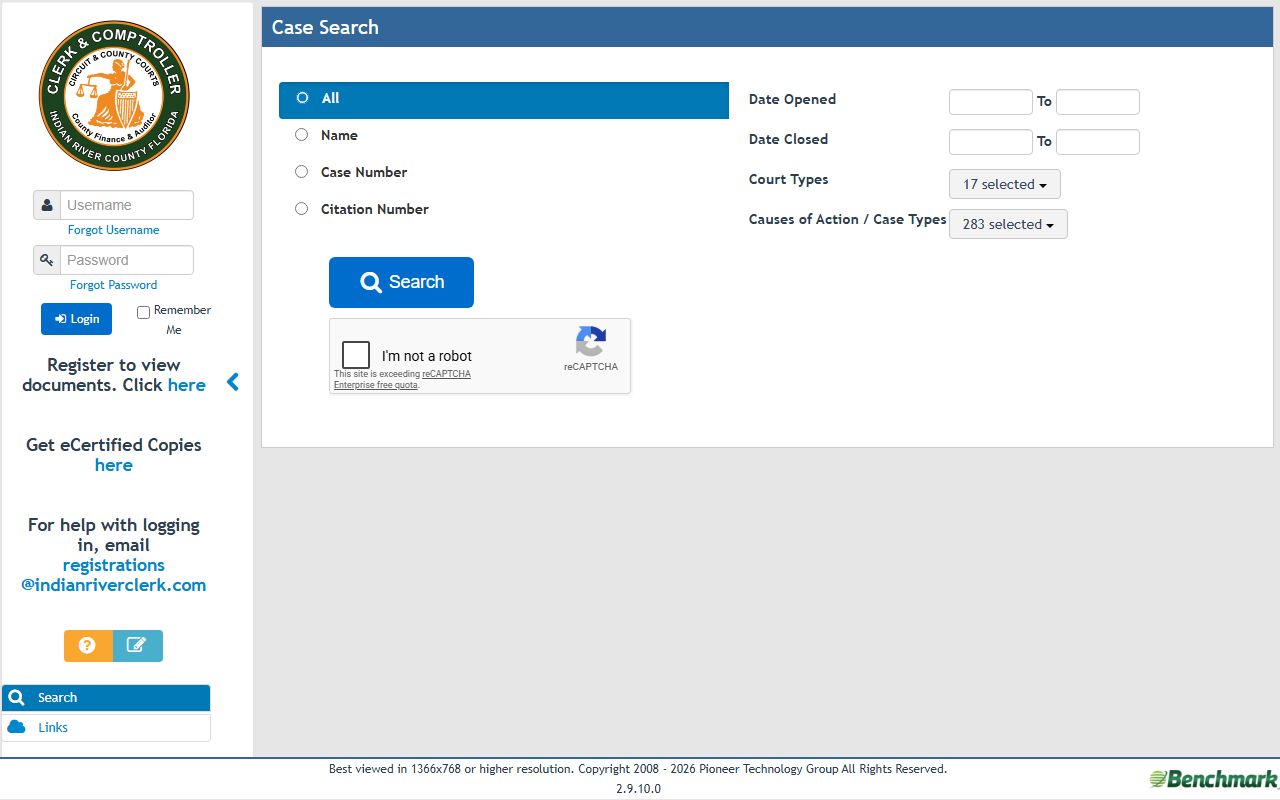
The search page lets you filter by court type, such as Criminal Felony or Misdemeanor, which keeps a common-name search from pulling in unrelated civil or traffic cases.
The clerk also publishes a plain guide to the tool. The Online Case View information page explains what the public can see and how registered users access document images from late 2008 forward.
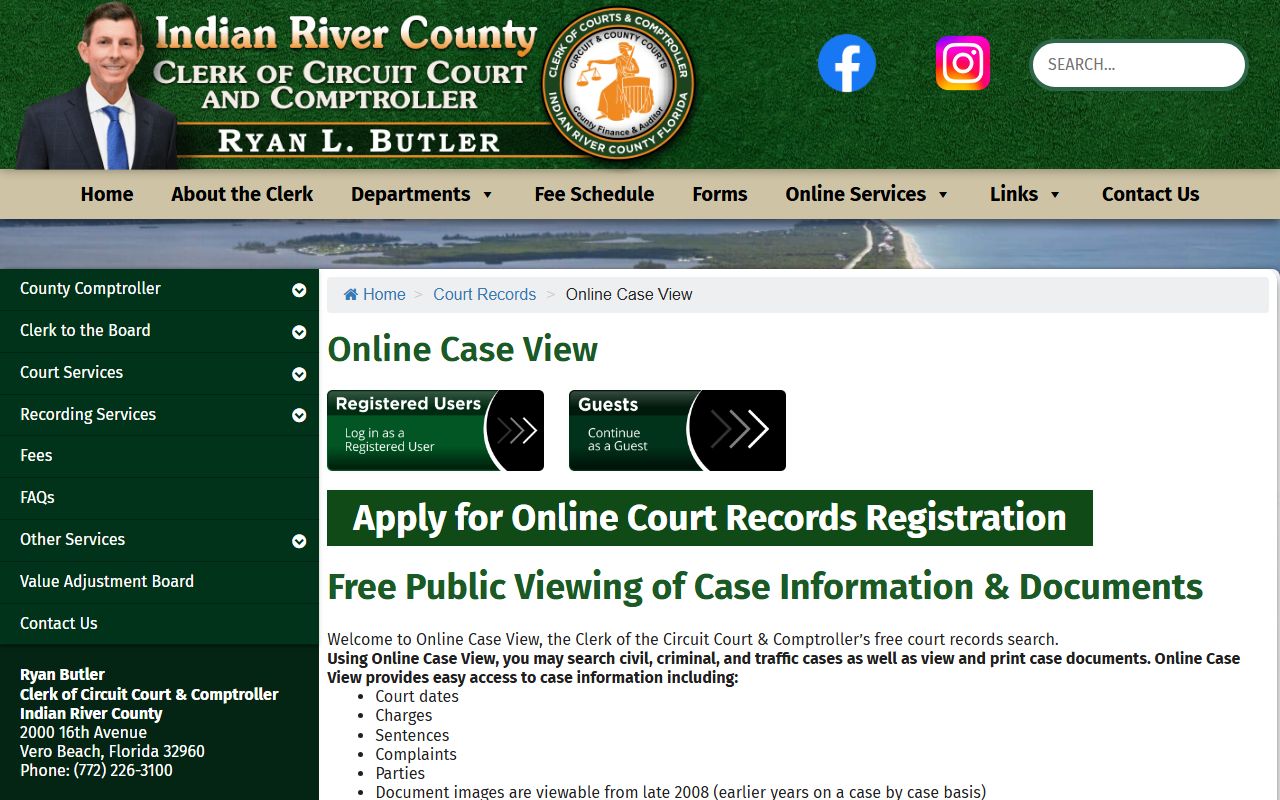
That page is useful when a case is older than 2008, since document images for those years are pulled case by case rather than shown automatically.
Charging Documents After an Indian River County Arrest
Booking happens first, then the charge record begins when the prosecutor files a charging document. The State Attorney reviews whether a crime was committed and whether there is a good-faith basis to prove the charges. The formal document in most Florida felony and misdemeanor cases is an information. If the evidence is not there, a "No Information" ends the matter. The most serious felonies can run through a grand jury indictment. The table sorts out the three main types.
| Complaint | Information | Indictment | |
|---|---|---|---|
| Filed By | Officer / Prosecutor | State Attorney | Grand Jury |
| Common For | Initial charges | Most felonies and misdemeanors | Most serious felonies |
| Starts | The case | The case | The case |
The State Attorney's process page says charges must be filed with the court within 21 days of the arrest, and arraignment generally follows two to four weeks after the information is filed.
Charge Status in Indian River County Court Records
Charges move as a case develops. A prosecutor can amend, reduce, add, or drop a count, so the charges that finally appear in the court record may not match the booking charges. A booking profile might show "Set for Arraignment," while the court file later shows a reduced charge or a dismissal. The terms below come up often when reading a case.
| Status | What It Means |
|---|---|
| Pending | The charge or case is still open and moving through the court. |
| Amended / Reduced | The prosecutor changed the charge or lowered it to a lesser offense. |
| Dismissed | The charge ended without a conviction. |
| Nolle Prosequi | The prosecutor chose not to proceed on the charge. |
Note: confirm any final disposition with the clerk or court, because the jail roster shows booking charges, not the court outcome.
Bond and Release After an Indian River County Arrest
Bond is set at or before first appearance. If no bond has been set, the person waits for the judge to set one at first appearance or, in some cases, the next court date. The 19th Judicial Circuit adopted Florida's uniform statewide bond schedule for releases before first appearance, and that order also holds non-citizens charged with any felony without bond until first appearance. Bond can be paid in cash, in full at the jail or online, or posted through a registered bail bondsman.
| Bond Type | How It Works |
|---|---|
| Cash Bond | The full amount is paid directly at the jail or online when available. |
| Surety Bond | A registered bail bondsman posts the bond through a surety company. |
| Cash Surety | A roster bond type where either a cash or a surety route may satisfy it. |
| No-Bond Hold | No release bond is available, often pending first appearance or a hold. |
Even with a bond amount posted, a person can be held by another agency's detainer, a warrant, or a court order, so release eligibility should be confirmed with the jail or court.
Warrants Behind an Indian River County Arrest
Many bookings begin with a warrant. An arrest warrant authorizes taking a person into custody, and once served the booking appears on the jail roster. A bench warrant often follows a failure to appear and may sit in the court docket until served. The sheriff does not publish a standalone public warrant search, but the agency directory lists a Warrants Unit line at (772) 978-6719, and tips on a wanted person can go to (772) 978-6200. For bench-warrant and failure-to-appear status, the clerk's case index is the better source, and a public records request to the sheriff is the fallback for warrant-related arrest records.
Felony and Misdemeanor Court Records in Indian River County
Where a case lands depends on the charge. The 19th Judicial Circuit's Circuit Criminal Division hears major felonies, those that can bring a year or more in state prison, and it also hears appeals from county criminal court. The County Criminal Division handles minor misdemeanors, criminal traffic, and county or municipal ordinance matters, with examples like petit theft, simple battery, trespassing, and driving while license suspended. The clerk notes that a county jail sentence tops out at one year, and any longer term means placement with the Department of Corrections.
The court record reflects that split. A felony filed by the State Attorney opens in circuit court, while a misdemeanor opens in county court, and the clerk's case search lets you filter by court type to keep the two apart. Felony classifications run from third degree up through first degree, life, and capital felonies.
Charges vs. Convictions
An arrest and a charge are accusations, not proof. A booking record shows what a person was arrested for, and a charge shows what the prosecutor filed, but neither is a conviction. A conviction comes only from a plea or a verdict in court. The booking profile says so directly, noting that the record does not constitute a conviction.
| Charge | Conviction | |
|---|---|---|
| Stage | Accusation | Verdict or plea |
| Burden of Proof | Probable cause | Beyond a reasonable doubt |
| Public Record | Yes | Yes |
Sealed vs. Expunged Arrest Records
Florida lets people clear qualifying records after an eligible disposition. Sealing restricts public access while keeping limited agency access, and expunction removes the record from public access entirely. Both run through the Florida Department of Law Enforcement, which says a Certificate of Eligibility is the first step and that no relief happens until a certified court order reaches the agency. The clerk and the FDLE seal-and-expunge process handle the steps.
| Sealed | Expunged | |
|---|---|---|
| Visibility | Hidden from public view | Treated as never existed for the public |
| Law Enforcement | Limited access remains | Very limited access |
| Eligibility | Florida Statutes § 943.059, certificate required | Florida Statutes § 943.0585, court order required |
Details are on the clerk's seal and expunge page and the state's FDLE seal and expunge process.
Background Check Considerations
There is a real difference between a casual records lookup and a regulated background check. A formal background check used for hiring, housing, or credit is governed by the federal Fair Credit Reporting Act and must run through a compliant consumer reporting agency. Reading a public court record for personal information is not the same thing.
Important: This site is not a consumer reporting agency under the FCRA, and its content cannot be used for employment, tenant, credit, or insurance screening.
Restricted Court Records After an Arrest in Indian River County
Not every record is open. Online Case View leaves out sealed and non-public cases, juvenile matters except for the attorney of record, mental-health and Baker Act cases, and injunction petitions until the respondent is served. Florida's public-records exemptions also withhold active criminal investigative information, some personal data, and juvenile records. A dismissed charge can still appear in the court file unless it is later sealed or expunged, so a clean court outcome and a cleared public record are two separate steps.